Industrial table saws and panel saws serve different functions. Table saws handle cross-cuts and narrow workpieces, while panel saws manage large panels with better accuracy and throughput. Selection depends on material size, volume, and required precision.
- Industrial table saws excel at cross-cuts and small workpieces but face limits in panel size.
- Panel saws provide higher throughput and better accuracy for large-format materials.
- Fence and blade setup are the main drivers of repeatable quality on both machines.
- Choose based on dominant material size, cut volume, and required dimensional accuracy.
What is the core difference between these two machines
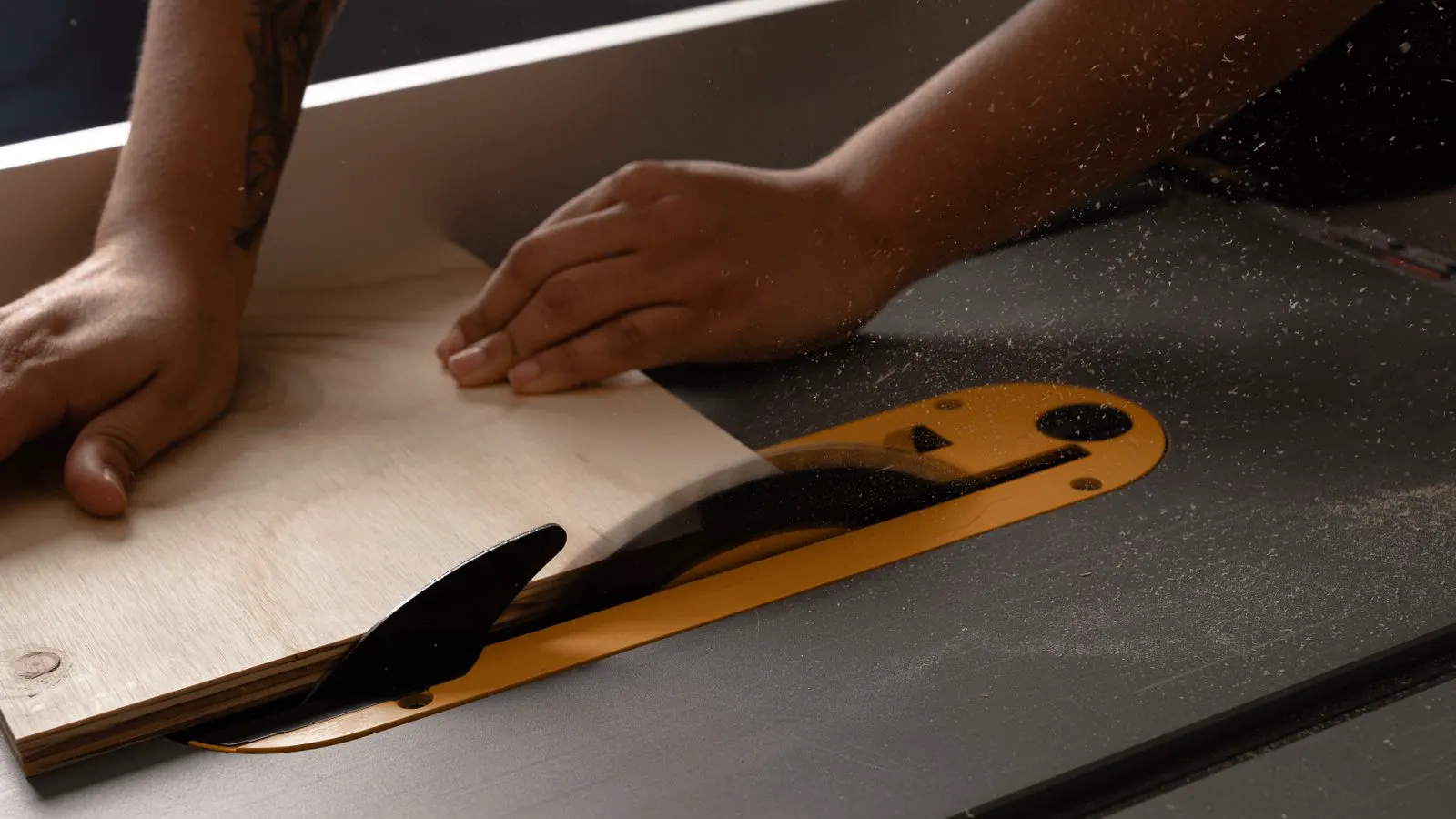
An industrial table saw and a panel saw solve different problems. A table saw holds the workpiece on a flat table and moves it through a fixed blade. A panel saw holds the blade and moves the workpiece, or holds the workpiece and moves a large blade assembly. This difference drives every other comparison point.
The table saw is a precision tool for narrow parts. The panel saw is a production tool for sheets, panels, and long boards. An engineering lead evaluating a new line will ask what the dominant material size is. If the shop cuts 4x8 sheets or large cabinetry panels, a panel saw is the natural fit. If the shop mostly cuts narrow stock for trim, moldings, or small fixtures, a table saw is the better base.
Both machines share basic safety logic. Blade guards, riving knives, and interlocks are standard on modern units. The difference is in how the machine constrains the workpiece and how the operator controls the cut.
Cutting limits and workpiece size
The table saw has a physical ceiling. The distance from the blade to the fence, the width of the table, and the height of the workpiece all limit what can be cut. Narrow pieces are easy. Wide panels are not.
A panel saw handles large formats. The workpiece rides on a bed or is clamped in a fixture, and the blade moves across it. The cut length is often limited by the machine bed or by the travel of the saw head. The cut width is limited by the blade diameter and the machine frame.
For a shop that mixes sizes, the question is which size drives the bottleneck. If large panels must be cut daily, a table saw will not keep up. If narrow parts dominate, a panel saw may be overkill and cost more to run.
A common mistake is buying a table saw with a large extension table and expecting it to perform like a panel saw. The extension helps with support, but it does not solve the fundamental problem of moving a large, heavy panel through a fixed blade with the accuracy needed for production work.
Accuracy and repeatability
Accuracy is where the panel saw usually wins. The machine controls the fence position, the blade position, and the workpiece position. The operator makes fewer adjustments per cut. This makes repeatable cuts easier, especially at volume.
A table saw depends heavily on the operator. The fence must be set, the workpiece must be fed straight, and the blade must be aligned. Small errors compound. A few millimeters of error in the fence can show up as a visible gap in a cabinet frame.
Panel saws often include digital readouts or servo-controlled axes. These systems reduce setup time and reduce the chance of operator error. For a high-volume shop, that consistency is the real value. The machine does the work of holding tolerance.
A table saw can be highly accurate when the setup is right. But it requires disciplined setup every time. The fence must be checked. The blade must be aligned. The workpiece must be supported. An engineering lead should ask how many cuts per shift are expected and how much setup time is acceptable.
Throughput and workflow
Throughput is the second major decision factor. A panel saw is built for moving material through a production line. The operator loads the panel, selects the cut, and the machine performs the cut. The cycle time is short. The next panel can be loaded quickly.
A table saw is slower per cut. The operator positions the workpiece, feeds it through the blade, and then removes the cut piece. For narrow parts, this is fine. For large panels, the process becomes cumbersome and risky.
Consider a shop that cuts 4x8 sheets for cabinetry. A panel saw can cut multiple panels in a row. A table saw would require the operator to move the sheet, position it, cut, remove the offcut, and repeat. The time difference is significant. The labor cost is significant. The risk of damage to the panel is significant.
A numbered list of typical workflow steps helps make the difference clear:
- The operator loads the panel onto the panel saw bed.
- The operator selects the cut position on the control panel.
- The saw head moves and makes the cut.
- The operator removes the cut panel.
- The next panel is loaded and the cycle repeats.
On a table saw, the operator must do most of these steps by hand. The workpiece moves, not the machine.
Cost and operating model
The capital cost of a panel saw is generally higher than that of a table saw. The machine is larger, more complex, and often includes digital controls, servo axes, and larger structural frames. The installation space is larger. Power requirements are higher.
The operating cost is different too. A panel saw is more energy efficient per cut because the machine does the work of moving the blade. A table saw consumes energy as the operator feeds the workpiece through the blade. The blade life may differ too. Panel saw blades are often larger and designed for heavy-duty cutting. Table saw blades are smaller and may wear differently depending on the material.
For a small shop, the table saw is the lower barrier to entry. The machine is easier to install, easier to maintain, and easier to operate. For a large shop, the panel saw is the better economic choice. The higher capital cost is offset by lower labor cost, higher throughput, and better quality consistency.
A practical rule is to calculate the cost per finished part. A table saw may have a lower machine cost, but a higher labor cost per part. A panel saw may have a higher machine cost, but a lower labor cost per part. The total cost of ownership decides.
Safety and operator training
Both machines require training. The risk profile is different. A table saw presents a higher risk of kickback when the workpiece is not properly supported or when the operator feeds the workpiece unevenly. The blade is exposed for a longer portion of the cut. The workpiece is moving in the operator’s hands.
A panel saw reduces kickback risk because the workpiece is usually clamped or held in a fixture. The blade moves across the workpiece, and the workpiece does not move in the operator’s hands. This makes the machine safer for large panels.
However, a panel saw is not risk-free. The blade is large and can cause serious injury if the operator reaches across the cut line. The machine has heavy moving parts. The workpiece can shift if the fixture is not secured.
Training should cover blade setup, fence alignment, workpiece clamping, and emergency stop use. A shop should have written procedures and regular drills. The machine itself does not replace good practice.
When to pick each machine
The decision comes down to the shop’s dominant workflow. A table saw is the right choice when the shop cuts narrow parts, does a lot of cross-cuts, and has limited space. The machine is versatile and can be used for many types of cuts. It is also easier to maintain and repair.
A panel saw is the right choice when the shop cuts large panels, has high volume, and needs consistent accuracy. The machine is built for production. It reduces operator error and increases throughput. It is the better choice for cabinetry, flooring, and large-format wood products.
A mixed shop may need both. A panel saw for large panels and a table saw for narrow parts and small fixtures. The table saw handles the work that is too small or too irregular for the panel saw. The panel saw handles the work that is too large for the table saw.
The engineering lead should look at the last year of production data. What is the size distribution of parts? What is the cut volume? What is the required accuracy? What is the labor cost per shift? These numbers drive the decision. The machine is not a luxury. It is a tool that must fit the work.
Common mistakes to avoid
One mistake is buying a table saw with an extension table and expecting it to cut panels. The extension table does not solve the problem of moving a large panel through a fixed blade. The workpiece is still moving, and the operator is still in control.
Another mistake is buying a panel saw without a proper fixture system. The machine is only as good as the fixture. If the panel is not clamped properly, it can shift during the cut. The accuracy drops, and the operator has to rework the part.
A third mistake is ignoring fence alignment. Both machines depend on a well-aligned fence. A small error in the fence can cause a large error in the cut. The fence must be checked regularly. The blade must be aligned to the fence. The workpiece must be supported.
A fourth mistake is not training the operator. A machine is only as good as the person operating it. The operator must understand the machine, the safety features, and the setup procedures. Training should be documented and repeated.
Maintenance considerations
Both machines need regular maintenance. The table saw needs blade cleaning, fence checking, and table leveling. The panel saw needs blade cleaning, axis calibration, and fixture checking. The maintenance intervals depend on usage.
The panel saw has more moving parts. The axes must be calibrated. The controls must be checked. The blades must be inspected. The table saw has fewer moving parts, but the fence and blade are critical.
A preventive maintenance schedule is essential. The machine should be cleaned after each shift. The blades should be inspected for damage. The fences should be checked for alignment. The controls should be tested. The documentation should be kept.
The machine that is maintained well will perform well. The machine that is ignored will fail. The failure will cost money in downtime and in poor quality. The maintenance plan is part of the total cost of ownership.
Final selection criteria
The selection criteria are simple. Material size, cut volume, required accuracy, labor cost, and space. The material size decides the machine type. The cut volume decides the capital cost. The required accuracy decides the control system. The labor cost decides the operating model. The space decides the installation.
An engineering lead should not choose the machine based on brand or reputation. The machine must fit the workflow. The workflow is the work that must be done. The machine is the tool that does the work. Match the tool to the work, and the shop will run well.
Frequently asked questions
Can an industrial table saw cut large panels?
It depends on the panel size and the table saw capacity. Many table saws have extension tables, but they are not designed for the high accuracy and throughput needed for large panel production.
What is the main advantage of a panel saw?
The main advantage is consistent accuracy and high throughput. The machine controls the cut, reducing operator error and increasing production speed.
Is a table saw safer than a panel saw?
Both require training and proper safety practices. A table saw presents a higher kickback risk when the workpiece is not properly supported. A panel saw reduces kickback risk but has other hazards.
How do I decide which machine to buy?
Look at your dominant material size, cut volume, required accuracy, labor cost, and space. The numbers in your production data should drive the decision.
Can a shop use both machines?
Yes. Many shops use a panel saw for large panels and a table saw for narrow parts and small fixtures. The machines complement each other in the workflow.